
Last updated: April 24, 2026
Legal Disclaimer: This post is for general informational purposes only. It does not constitute legal, tax, or financial advice and should not be relied upon as such. While every effort has been made to ensure accuracy as of the date of publication, UK company law and HMRC guidance can change. If you are facing a specific compliance issue, a pending court deadline, or uncertainty about your company’s legal obligations, please instruct a qualified UK solicitor or accountant. Reading this post does not create any professional relationship between you and the author.
Here Is the Answer — Before Anything Else
You change your UK registered office address by filing form AD01 with Companies House (You can do it online in about five minutes. It costs nothing), Companies House usually processes it within 24 hours, and your new address shows up on the public register the same day.
That is the simple part.
Here is what nobody tells you: once that change goes through, your old address stays legally valid for receiving court documents for 14 more days.
Not in a vague, “probably fine” way. In a “a judge will uphold it” way.
If you have already walked away from that old address (and most non-resident founders have) you may be completely invisible to a claim that is being filed against your company right now.
I have seen this catch people badly.
Let me walk you through exactly what is happening, why it matters more if you are based outside the UK, and what you can do about it today.
What You Are Actually Doing When You File AD01
The process itself is easy
Your registered office address is the official address for your UK company. It goes on the public register. It is where Companies House, HMRC, and the courts send documents.
It has to be a physical address (not just a PO Box) and it has to be in the same part of the UK where you incorporated. If your company is registered in England and Wales, your address has to stay in England or Wales. You cannot move it to Scotland or Northern Ireland.
To change it, you fill out form AD01 on the Companies House Web Filing portal. Free. Online. Done in minutes. Once it processes, your new address is live on the register.
Here is the thing, though.
You probably think “live on the register” means the old address is dead. It doesn’t. And this is where things get interesting or depending on your situation, quite stressful.
The 14-Day Rule and Why It Hits Non-Residents Hardest
This is the part your formation agent did not mention
I want to be direct with you here, because I think this is genuinely important and it tends to get buried in legal language.
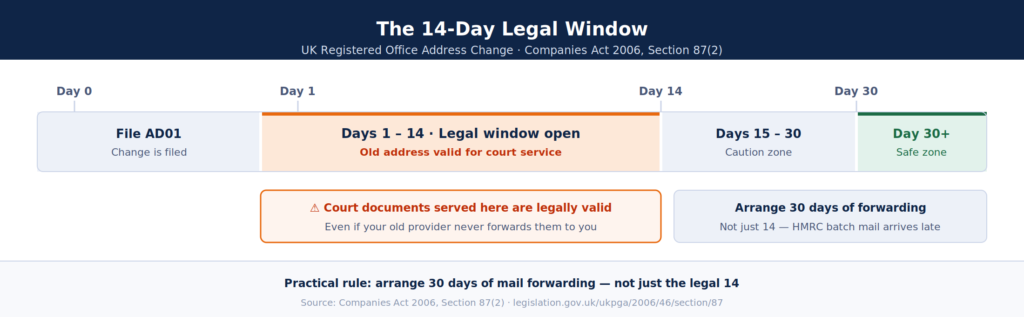
When Companies House registers your address change, a 14-day window opens.
During those 14 days, anyone — a creditor, a claimant, a solicitor acting for someone who has a dispute with your company — can legally serve documents on your company at your old address. The court will treat that as valid service. The company cannot argue otherwise.
That comes straight from the Companies Act 2006, Section 87(2). It is not obscure. It is not an edge case. It is the law.
Now think about what this means in practice.
You incorporated using a formation agent’s address in London. You have since switched to a different registered office provider (maybe a better price, maybe a more central address for client meetings, maybe you just wanted faster mail scanning). You filed AD01. The new address is on the register. You have mentally moved on.
Your old formation agent’s contract ended the day you switched. Under most standard terms, they are under no obligation to forward anything received after that contract date. Some do. Many do not.
A claim form arrives at that old address on day 9 of your 14-day window. Legally valid service. Nobody calls you. Nobody forwards it. The deadline to respond passes. A default judgment is entered against your company, and you find out when your new bank application comes back rejected because of a CCJ on your credit file.
I am not inventing this scenario. It happens. And it happens most often to non-resident founders, people who have never physically visited their UK registered office, who chose it because a formation agent offered it, and who have no personal relationship with whoever is holding their old mail.
The 30-day rule I use instead
Here is my practical rule, and it is more conservative than the legal minimum: do not treat your old address as fully dead until 30 days have passed, not 14. Why?
Because HMRC and some other government bodies use batch mailing. A notice triggered before your address change was processed may still be in the postal system when the 14-day window closes. It lands at the old address on day 18. It is not a court service document, so the 14-day legal rule doesn’t apply. But the deadline on that notice has still been ticking.
Thirty days of overlap forwarding costs almost nothing — typically £20 to £50 from any professional registered office provider. It closes a gap that could otherwise cost you hundreds in penalties or thousands in legal fees.
What the Official Rules Say (Directly From the Source)
You should read this yourself, not just take my word for it.
The statutory authority is Section 87(2) of the Companies Act 2006, which states:
“Until the end of the period of 14 days beginning with the date on which it is registered a person may validly serve any document on the company at the address previously registered.”
You can read the full section here: https://www.legislation.gov.uk/ukpga/2006/46/section/87
For the AD01 filing process itself, Companies House guidance is here: https://www.gov.uk/government/publications/change-a-registered-office-address-ad01
One more thing that trips people up: changing your registered office at Companies House does not update your address with HMRC.
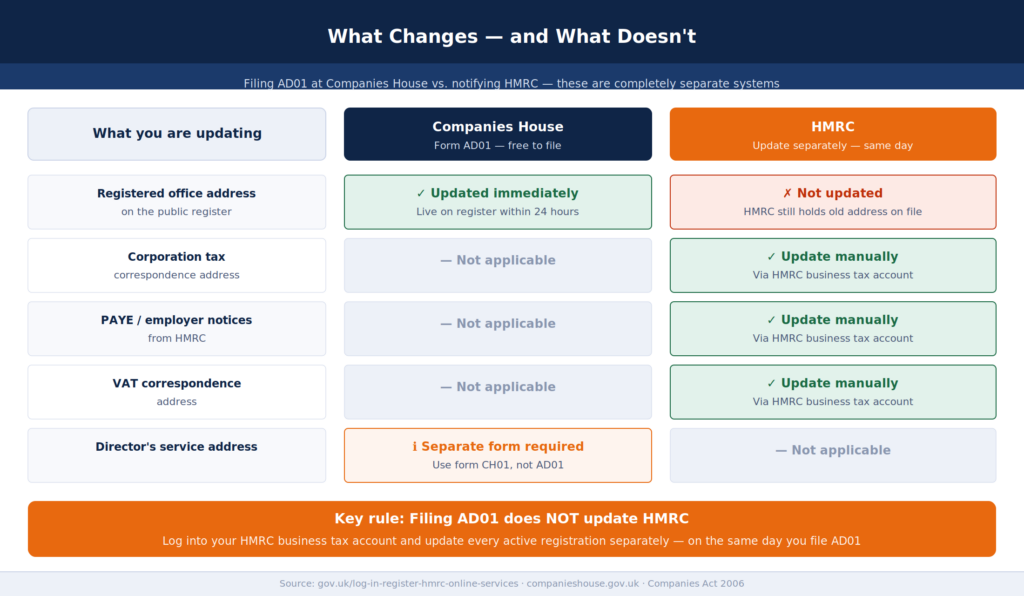
These are completely separate systems. Your corporation tax correspondence, PAYE notices, and VAT mail all route to whatever address HMRC has on file for you and that address does not update automatically when you file AD01.
You need to update HMRC separately, via your business tax account, for each active tax registration. Do it the same day you file the Companies House change. Not later. The HMRC business tax account is at: https://www.gov.uk/log-in-register-hmrc-online-services
What Happens If You Get This Wrong
The numbers are specific
I want you to understand what “getting this wrong” actually looks like. Not in a vague “there may be consequences” way. In a specific, this-is-what-it-costs way.
If a court claim goes unanswered:
A default County Court Judgment (CCJ) gets entered against your company.
It sits on your company’s credit file for six years.
You will struggle to open a UK business bank account.
You will struggle to get trade credit.
Many commercial landlords will not sign a lease with you.
If you want to have the judgment set aside, you need to make a formal court application. That costs £303 as of 2026. You also need to show that you have an arguable defence to the original claim and explain why you failed to respond. “I changed my registered office and nobody forwarded the post” is not automatically a winning argument. Courts have heard it before.
If an HMRC notice goes unanswered:
Corporation tax late filing penalties start at £100 for filing up to three months late. They rise to £200 for over three months. If you miss a tax return entirely, HMRC can apply a tax-geared penalty of up to 10% of the outstanding tax for returns that are more than 18 months late.
HMRC does have a “reasonable excuse” appeal process. But you need to document everything: when you changed the address, when you notified HMRC, what steps you took. “I assumed it updated automatically” will not succeed.
In the worst cases — a pattern of unreachable addresses:
If Companies House repeatedly cannot serve documents on your company because the registered office is not functioning, they can begin striking-off proceedings.
If your company is struck off while it has active debts, directors can face personal liability.
And if the Insolvency Service gets involved, director disqualification proceedings can result in a ban from acting as a company director for anywhere between 2 and 15 years.
That is the extreme end of the spectrum, and the 14-day gap alone will not put you there. But it can start a chain.
And chains like this are much easier to break at the first link.
If you have just read through the consequences above and realised you are not sure whether your own setup is airtight, the checklist down below was built for exactly that moment. It covers the gaps most formation guides do not mention (the ones that show up when you try to open a bank account or pass a KYC check)
Five Steps You Can Take Today
These are not generic. Each one is something you can actually do right now.
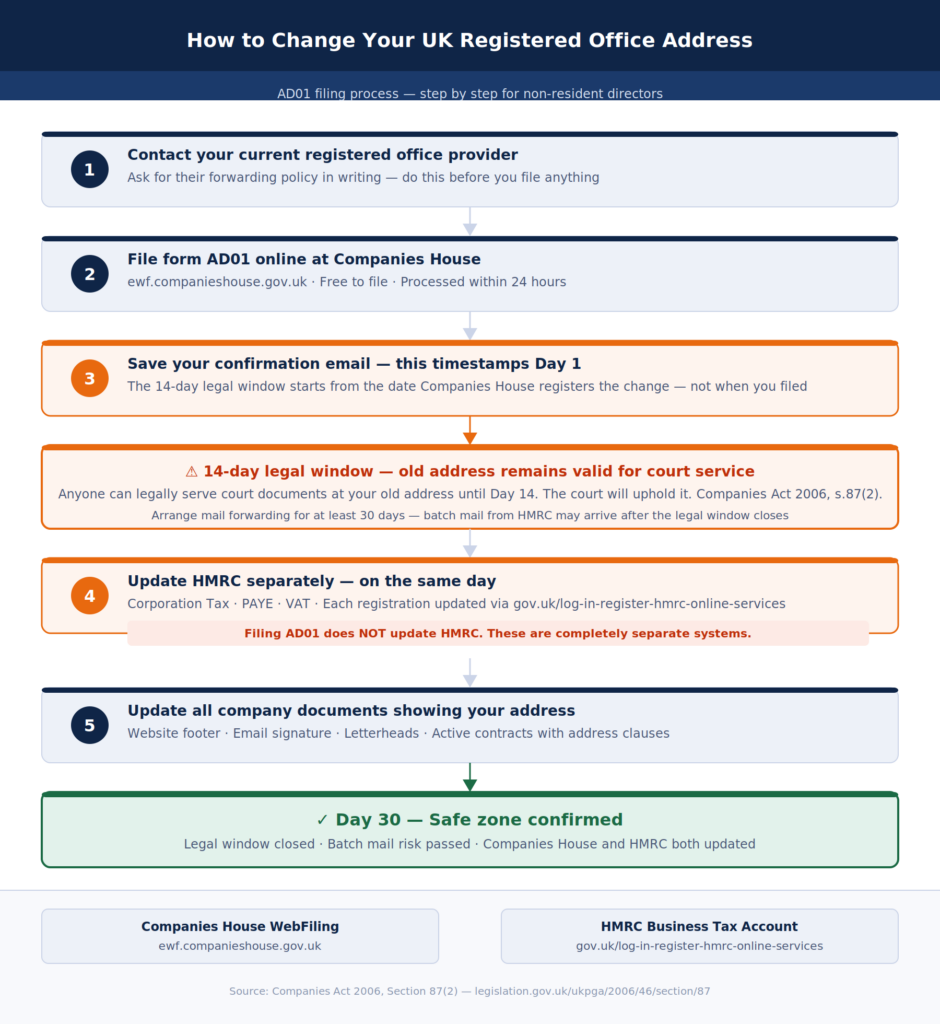
1. Before you file anything, email your current registered office provider today.
Ask them in writing: how long after my contract ends will you forward mail received at this address? Get their answer in writing. If the answer is “we don’t forward,” ask whether you can pay for a forwarding extension. Thirty days of forwarding is standard. If they will not provide it, factor that into your timeline before you file AD01.
2. File online, not by post (and save your confirmation email.)
The Companies House WebFiling portal at https://ewf.companieshouse.gov.uk processes changes within 24 hours and sends you a confirmation email showing the exact date your change was registered. That date is the start of your 14-day window. Save that email. If a dispute ever arises about when the change took effect, that is your evidence.
3. Open your calendar right now and block out day 15.
Count 14 days from your registration date. Put something in your calendar on day 15 that says “confirm no mail received at old address.” If you have a forwarding arrangement, keep it running until day 30 anyway. This takes 30 seconds and closes the gap completely.
4. Update HMRC separately (today, not next week.)
Log into your HMRC business tax account and update the correspondence address for every active tax registration: Corporation Tax, PAYE if you have it, VAT if you are registered. Do this on the same day you file AD01. HMRC and Companies House are separate systems and they do not talk to each other.
5. Check your company documents and any contracts that reference your address.
Your registered office address must appear on your company letterhead, website, emails, and invoices. Once the change is registered, update these immediately. Also pull any active commercial contracts — leases, supply agreements, credit facilities — and check whether they specify your registered office as the address for legal notices. Under many standard contracts, service to a contractually specified address is valid even if it is no longer your registered office. You may need to issue a formal notice-of-change letter under the relevant clause.
Frequently Asked Questions
How do I change my registered office address in the UK?
You file form AD01 with Companies House (online via the Web Filing portal at ewf.companieshouse.gov.uk). It is free and takes about five minutes. Companies House typically processes it within 24 hours and your new address appears on the public register the same day. You do not need a solicitor to do this. You do, however, need to notify HMRC separately, as the two systems do not update each other automatically.
How long does it take to change a registered office address at Companies House?
If you file online, the change is usually processed within 24 hours (often faster). Postal filing via form AD01 takes longer, typically five to ten working days. Online is always the better option because it generates a timestamped confirmation email, which records the exact date your 14-day legal window begins. That date matters more than most people realise.
Does changing my registered office address update my HMRC records automatically?
No. Companies House and HMRC are completely separate systems. Changing your registered office at Companies House does not update your corporation tax, PAYE, or VAT correspondence address with HMRC. You need to update each registration separately via your HMRC business tax account. Do this on the same day you file AD01 (not afterwards)
What is the penalty for not having a valid registered office address in the UK?
If your registered office is not a functioning address (meaning Companies House or the courts cannot successfully serve documents there), your company can be struck off the register. Directors of a struck-off company that has outstanding debts can face personal liability for those debts. In serious cases, the Insolvency Service can pursue director disqualification, with bans ranging from 2 to 15 years. Letting a registered office lapse is treated as a compliance failure, not a minor administrative oversight.
Can I use a PO Box as my UK registered office address?
No. Your registered office must be a physical address at which documents can be formally served. A PO Box alone does not satisfy this requirement under the Companies Act 2006. Many non-resident founders use a registered office service provider (a company that offers a physical UK address specifically for this purpose). This is legal and widely used, but it comes with its own risks: you need to be confident that your provider will actually scan and forward documents promptly, including during the 14-day window after you change address.
I am based outside the UK. Does the 14-day rule affect me more than a UK-based director?
Yes, significantly. A UK-based director switching from one office address to another usually has some form of personal connection to the old address (a relationship with the building manager, a former colleague, someone who might pick up the phone). Non-resident founders using a formation agent’s address in London or Birmingham typically have no such relationship. When your contract with that agent ends and a legal document arrives at their address on day 9 of the 14-day window, there is no one with any incentive to contact you. The document sits there. The clock runs. This is the specific failure mode this post is written to prevent.
If I change my registered office address, do I need to update my company website and emails too?
Yes, and this is a legal requirement — not just good practice. Under the Companies Act 2006 and the Company, Limited Liability Partnership and Business (Names and Trading Disclosures) Regulations 2015, your registered office address must appear on all company letterheads, order forms, emails, and your company website. Failing to display the correct registered office address is a criminal offence carrying a fine of up to £1,000 for the company and up to £1,000 for every officer in default. Update your website footer, email signature, and any business stationery on the same day the change is registered.
Can my registered office address be in a different country to where I live?
Yes — and this is one of the most common setups for non-resident founders. You can live anywhere in the world and have a UK registered office address, provided that address is in the same part of the UK where your company was incorporated. What you cannot do is have your registered office in Scotland if your company was incorporated in England and Wales, or vice versa. The registered office must be reachable and capable of receiving formal documents. Living outside the UK does not affect your compliance obligations — it just makes the practical management of your registered office more important to get right from the start.
Two More Posts Worth Your Time
If you are still deciding which registered office address to use, read our Icon Offices review — What Non-Resident Founders Need to Know Before Signing Up
And if the formation itself is still on your list, our Mint Formations Review — That £4.99 Package Actually Costs £124.99 covers the hidden costs most founders hit before they ever get to the address question.
Disclaimer: The information in this post is provided for general educational purposes only and reflects the law and HMRC guidance as understood at the date of publication (April 2026). It does not constitute legal, tax, or financial advice. No reader should act or refrain from acting on the basis of this content without first seeking independent professional advice suited to their specific circumstances.
The author is not a solicitor, barrister, or regulated legal professional. References to the Companies Act 2006, Companies House processes, and HMRC procedures are included for informational purposes and are based on publicly available primary sources cited throughout this post. Laws and procedures may change after the date of publication.
The penalty figures, court fees, and timelines referenced in this post are accurate as of April 2026 to the best of the author’s knowledge but should be independently verified before being relied upon. If your company has missed a legal deadline, is subject to a court claim, or is facing HMRC enforcement action, instruct a qualified UK solicitor immediately.
Statutory reference: Companies Act 2006, Section 87(2) — https://www.legislation.gov.uk/ukpga/2006/46/section/87 Companies House guidance: Form AD01 — https://www.gov.uk/government/publications/change-a-registered-office-address-ad01