
Estimated reading time: 11 minutes
Affiliate Disclosure: This post is reader-supported. If you buy through my links, I may earn a commission at no extra cost to you. I only review services I have personally tested.
My Verdict on Mint Formations

UK Company Formation Agent
Summary
Best For
UK residents forming a single company who want a low agent fee and don’t mind doing their own due diligence
Avoid If
You are a non-resident, need a clear all-in price upfront, or are comparing costs without accounting for the £100 Companies House filing fee
Bottom Line
The headline price starts at £4.99. The actual minimum outlay starts at £124.99 including VAT. That gap is the whole story.
What Happened When I Tried to Use Mint Formations
November 2023, 3:45 PM GMT, Sheffield. I was running a back-to-back comparison of formation agent checkout flows — timing them, logging friction points, noting exactly where costs appeared and where they didn’t.
Mint Formations was third on my list that afternoon. The homepage looked professional. Pricing page was clean, easy to scan. I picked a package, clicked through, and started filling in the form.
Twenty minutes. Company name, director details, SIC code, share structure, registered office preference, service address decision. The full process — the same data a real founder would enter on their first incorporation. I was not skimming it. I wanted to know exactly what the experience felt like from the inside.
Then I got to the payment screen.
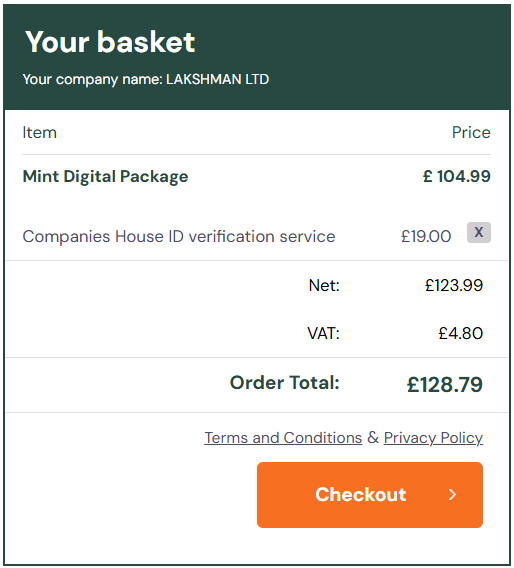
There it was: an £19 verification fee. Not mentioned on the pricing page. Not in the package comparison table. Not flagged during the form. Added as a line item at the final step, after I had already invested 20 minutes of real data entry. The kind of fee that appears when backing out feels like more effort than just paying it.
I abandoned the cart and incorporated with 1st Formations instead. Transparent pricing from page one. No surprises at checkout.
That session changed how I approach every formation agent review I write. Before I commit real company data to any form, I run a test cart through to the payment screen first. Five minutes of friction now saves a founder from a budget miscalculation later.
What I did not know in November 2023 was how much Mint Formations would change by 2026. The package structure is different. The Companies House fees are different — significantly so, after the February 2026 increases. This review covers what the service actually looks like today, not what I tested two years ago.
What Mint Formations Actually Offers in April 2026
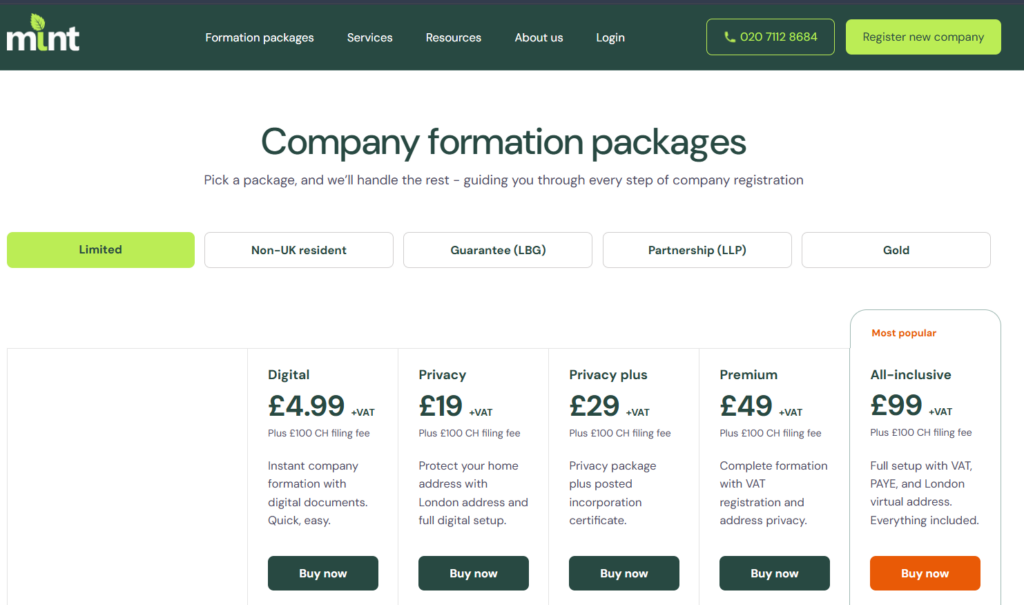
Mint Formations currently runs five packages. Not three, as several older reviews still describe — the structure has changed since 2023, and if you are reading a review that shows a Basic, Standard, and Premium layout, you are looking at outdated information.
The current lineup runs from a bare-bones digital-only option at £4.99 +VAT up to an all-inclusive package at £99 +VAT. Here is what each one covers as of April 2026:
| Package | Agent Fee (ex-VAT) | Registered Office | Director Service Address |
|---|---|---|---|
| Digital | £4.99 | No | No |
| Privacy | £19.00 | Yes | No |
| Privacy Plus | £29.00 | Yes | Yes |
| Premium | £49.00 | Yes | Yes |
| All-inclusive | £99.00 | Yes | Yes |
Now the figure that every competitor review I have read leaves out entirely: every single package above requires a mandatory £100 Companies House filing fee on top of the agent price.
This is a government fee paid directly to Companies House — it is not Mint’s charge, and it applies regardless of which agent you use. But it doubled from £50 to £100 on 1 February 2026 (confirmed here), and it does not appear next to the package prices on Mint’s pricing page.
The practical result: the Digital package does not cost £4.99. It costs £4.99 +VAT plus £100. The minimum you will pay to incorporate through Mint Formations is £124.99 including VAT. That is the number that should be on the pricing page. It is not.
One more thing worth knowing about Mint’s address product, and this one matters specifically for non-residents: Mint does not publish whether their London EC address is a staffed physical location or a virtual mail forwarding service.
For bank KYC — particularly with Tide and Starling — that distinction is checked. I will cover the banking implications in full in the section below.
My Full Cost Breakdown — What I’d Actually Pay as a Non-Resident
The Digital package is not a realistic option for most non-resident founders. No registered office means your incorporation will be rejected by Companies House — a UK Ltd requires a physical UK address on the public register from day one.
The Privacy package (£19 +VAT) gives you a registered office, but no director service address, which means your personal address in Chennai, Lagos, or Dubai goes on the public Companies House register and stays there. Google indexes it within days. I have written about exactly what that costs you in practice here.
The Privacy Plus package (£29 +VAT) is the minimum sensible starting point for a non-resident. It bundles both the registered office and the director service address into one package, which closes both gaps. Here is what that actually costs once you add every mandatory charge:
| Item | Cost |
|---|---|
| Privacy Plus agent fee | £29.00 +VAT = £34.80 |
| Companies House standard filing fee | £100.00 |
| Credit verification fee (verify at checkout — applied in my 2023 test) | £18.00 |
| Year 1 Total (Privacy Plus) | £152.80 |
If that number changes your thinking, 1st Formations shows you the all-in cost before you start the form (including the Companies House fee). No checkout surprises.
A few things to flag before you take that number at face value.
First, the VAT. Mint’s agent fees are shown ex-VAT throughout their pricing page. If you are incorporating as a non-VAT-registered sole director — which most first-time non-resident founders are — you cannot reclaim that 20%. It is a real cost, not a pass-through.
Second, the verification fee. I cannot confirm whether the £19 charge I encountered in November 2023 still applies at the current checkout.
It may have been absorbed into the package pricing, removed, or replaced with a different verification process. The only way to know is to run a test cart through to the payment screen before you commit your real company data. Do not skip this step.
Third, the £100 Companies House fee is the standard rate for digital incorporation. If you need same-day CRN — your company registration number issued the same working day — the Companies House fee rises to £156.
That is an additional £56 on top of the standard rate, and it applies at checkout regardless of which package you have chosen. Mint’s same-day service is real. The fee uplift for it is not prominently displayed.
The 2 Year Number That Mint Formation Doesn’t Show You
Formation agents compete on Year 1 pricing. Year 2 is where the real cost of your decision shows up — because the formation fee disappears, the address renewal stays, and a mandatory government filing lands that most first-time founders did not budget for.
Here is the honest two-year picture for the Privacy Plus package:
| Cost | |
|---|---|
| Year 1 | |
| Privacy Plus agent fee (inc. VAT) | £34.80 |
| Companies House standard filing fee | £100.00 |
| Credit verification fee (if applicable — verify at checkout) | £18.00 |
| Year 1 Total | £152.80 |
| Year 2 | |
| Registered office + service address renewal (inc. VAT) | ~£34.80 (verify renewal rate at checkout — renewal pricing may differ from first-year rate) |
| Confirmation Statement — CS01, digital filing | £50.00 |
| Year 2 Total | ~£84.80 |
Year 2 is cheaper in absolute terms because you only pay the formation fee once. But two figures in that table need attention before you treat it as settled.
The first is the address renewal rate. Mint does not publish a confirmed renewal price on the main pricing page.
The ~£34.80 figure above assumes the renewal matches the first-year agent fee. That may not be the case — renewal pricing in this sector frequently runs higher than the introductory rate.
Ask Mint directly before you incorporate, not 11 months later when the renewal invoice arrives.
The second is the CS01 fee. The Confirmation Statement is a mandatory annual filing — every UK Ltd files one, no exceptions. The digital fee is currently £50, up from £34 before February 2026.
If you are reading an older review that quotes £34, that figure is wrong. The paper route costs £60 more at £110 — file digitally through your Companies House WebFiling account and save it immediately.
Neither of these figures is hidden maliciously.
But neither is prominently displayed during the formation process. You find out about the CS01 when Companies House emails you 12 months in. That is the moment most first-time founders realise their Year 2 budget was wrong.
Who Should Run Away From Mint Formations
Non-resident founders who need full cost transparency before they start.
Mint’s pricing page shows agent fees ex-VAT, does not feature the mandatory £100 Companies House filing fee alongside the packages, and — in my November 2023 test — added a credit verification fee at the final payment screen after a full form fill.
For a founder in Chennai or Lagos who has converted currency, planned cash flow, and budgeted to the pound, discovering a material cost difference at checkout is not a minor inconvenience.
It is a budget failure with a real exchange rate attached to it. If you need the all-in number before you start the form, Mint’s current pricing page does not give it to you.
Founders planning to open a Tide or Starling account immediately after formation.
Both banks run enhanced due diligence on non-resident directors and cross-reference registered office addresses during the application process.
Mint does not publish whether their London EC address is a staffed physical location or a virtual mail forwarding service.
That distinction matters to these banks — a confirmed physical address moves through KYC faster than an unconfirmed virtual one.
If your business account timeline is tight, start with an agent whose address provenance is explicitly documented. 1st Formations and Rapid Formations both confirm this upfront.
Anyone expecting same-day CRN without knowing the full fee.
Mint’s same-day service is real and it works — but same-day incorporation carries a £156 Companies House fee, not the standard £100.
That is an additional £56 at checkout that applies regardless of which package you have chosen, and it is not displayed alongside the same-day option on the pricing page.
A founder who has budgeted £100 for the Companies House fee and then selects same-day at checkout will be £56 short.
One line of disclosure on the pricing page would fix this entirely.
The Mistake That Cost Me 20 Minutes and My Patience
I should have tested Mint’s checkout before I started filling in their form. That is not on them — that is on me for assuming the payment screen would match the pricing page.
But here is the structural problem: a pricing page that shows £4.99 without showing the £100 Companies House fee alongside it is a pricing page designed to anchor you to the smaller number.
By the time you see the full cost, you have already invested time in the form. Sunk cost keeps you going. Mint is not unique in doing this — it is common across this sector.
The antidote is to abandon a test cart before committing real data.
I now do this for every formation agent I have not personally completed a live incorporation with. Takes five minutes. Has saved me (and my clients) from multiple surprises.
My Compliance Stack — What You Need Beyond Formation
Formation is one step in a longer process. Here is the full chain for a functional UK Ltd as a non-resident:
- Registered office address — Required by Companies House. Included from Privacy package upwards. Companies House requirements here.
- Director’s service address — Keeps your personal address off the public register. Included in Privacy Plus and above. What it is and why it matters.
- Business banking — Formation agents do not open your bank account. My full analysis of which banks accept non-residents (coming soon).
- Confirmation Statement (CS01) — Due 12 months from your incorporation date (not your accounting year end). The digital fee is currently £50. What it is and how to file it.
FAQ
Is Mint Formations legitimate?
Yes. They are an established UK company formation agent with a strong Trustpilot rating (4.9/5 across 524+ reviews as of April 2026). Their registered office address product is accepted by Companies House.
Why is there a credit verification fee at checkout?
Formation agents are required under UK anti-money laundering regulations to verify director identities. Many agents use third-party bureaus for this and pass the cost on. In my 2023 test, this was £18. Verify whether this still applies at checkout before you start filling in the form.
What does Mint Formations actually cost for a non-resident in April 2026?
Minimum viable option for a non-resident: Privacy Plus at £29 +VAT, plus £100 Companies House filing fee, plus any verification fees.
That is at least £152.80 before accounting for any add-ons. Always verify the current Companies House fee at GOV.UK — it changed twice between 2023 and 2026.
Does Mint Formations include a director’s service address?
The Privacy Plus (£29 +VAT) package and above currently include both a registered office and a director’s service address as bundled features. The Digital (£4.99) and Privacy (£19) packages do not include a service address.
Verify this on the live pricing page before purchasing, as package contents change.
Does Mint Formations include FreeAgent or accounting software?
As of April 2026, I cannot verify a FreeAgent partnership on their current pricing page. If accounting software is important to you, confirm with Mint directly before purchasing — do not rely on older reviews, including anything written before 2026.
How does Mint Formations compare to 1st Formations for non-residents?
1st Formations discloses the Companies House filing fee prominently alongside their agent fees, has explicit non-resident guidance published on their site, and documents their registered office address type. On those three criteria, 1st Formations is clearer for non-resident founders.
Can I change my registered office away from Mint Formations later?
Yes. Use Companies House form AD01. No Companies House fee for the change itself, but you will lose any remaining months on Mint’s address service.
What is the Companies House filing fee and why does no one mention it?
It is a mandatory government fee paid directly to Companies House on every new incorporation — £100 as of 1 February 2026, up from £50.
Formation agents are required to collect it but are not required to feature it prominently next to their own agent fee on pricing pages.
It is the largest single cost on your formation invoice and it appears on every agent’s checkout regardless of which agent you use. Always add £100 to whatever agent fee you are comparing.
Disclaimer: Based on personal experience and publicly available pricing as of April 2026. Package names, prices, and included features change — always verify against the live Mint Formations pricing page before purchasing. The £100 Companies House filing fee is confirmed as of April 2026 but is subject to change. Not legal or tax advice. Consult a qualified professional for your specific situation.