

Estimated reading time: 9 minutes
Transparency Note: This post is reader-supported. If you buy through my links, I may earn a commission at no extra cost to you.
Nobody tells you this before you incorporate!
Your UK limited company needs two addresses — not one. And if you skip the second one, your personal home address in Chennai, Lagos, or Dubai ends up on a public register that anyone can search, and that Google indexes within days.
I skipped it. Here’s what that cost me.
My Breakdown of the Two Addresses Every UK Ltd Needs
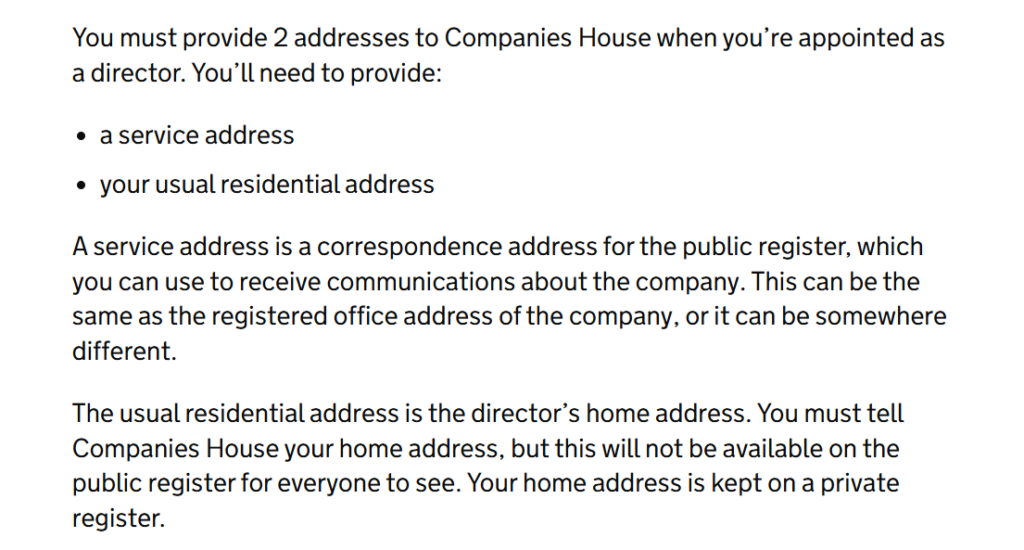
Under the Companies Act 2006, every UK limited company must maintain two separate addresses on the Companies House public register: a Registered Office — the official legal address of the company (Section 86) — and a Director’s Service Address — the publicly listed address for each individual director (Section 163).
Not interchangeable. Different legal purposes, different rules, and a distinction the incorporation form actively obscures. Most founders click through without reading. That is where the problems start.
What the Registered Office Actually Means for My Company
The Registered Office is your company’s legal address. Not yours — the company’s. Every official correspondence lands here: HMRC notices, Companies House reminders, corporation tax demands. If someone serves legal documents against your company, they get served here.
Three rules that matter if you are incorporating as a non-resident.
It must be a physical UK address. Companies House explicitly rejects PO Boxes — this was codified under the Economic Crime and Corporate Transparency Act 2023, effective March 2024. A virtual address at a registered business centre qualifies.
Someone receives mail there, it gets forwarded to you. A PO Box does not, because it cannot receive physical service of documents. First thing to check when comparing providers.
It must match your incorporation jurisdiction. England and Wales company means an England or Wales address. You cannot use a Scottish or Northern Irish address even if your provider operates across the UK. Check the postcode before you pay.
It is permanently on record. Every Registered Office your company has ever used stays visible in the Companies House filing history — even after you change it.
Update the current address using form AD01, but the historical record does not get wiped. If your home address was ever your Registered Office, even briefly, it stays in the history. No removal process exists.
And one more thing. If Companies House cannot deliver mail here — because your subscription lapsed, or your provider shut down — they will issue a warning and begin striking off your company. Reinstatement means either administrative restoration or a court order. Both cost considerably more than any address subscription ever would have.
What the Director’s Service Address Actually Does
The Service Address is your address — not the company’s. Yours, personally, as a director. Every director named on the incorporation must provide one. It hits the Companies House register the moment your company number is issued. Creditors, clients, the general public — anyone who wants to reach you in your capacity as a director gets directed here.
Here is the detail almost every guide skips.
Companies House accepts PO Boxes for Service Address, even though it explicitly rejects them for Registered Office.
The Registered Office must be a place where legal documents can be physically served. The Service Address only needs to be somewhere correspondence can reach you. Lower threshold, different rules — and a distinction that matters when you are comparing providers.
What this does not mean is that you should leave it as your home address. Use the cheapest compliant virtual address available and keep your personal address off the register. The cost difference is typically £26 to £39 per year from a reputable formation agent.
For that, your home address in Chennai or Lagos never appears on a public database that anyone can search for free and that has no removal mechanism once your address is in it.
One more thing nobody mentions. When you incorporate, you are almost certainly also a Person with Significant Control — a PSC. Companies House maintains a separate PSC register and requires an address entry there too. Also public.
Rush through the incorporation form and you can end up with your home address in three places simultaneously: Registered Office, Service Address, PSC entry. A founder I know discovered this four months after incorporating. Fixing all three cost him £340 in agent fees and six weeks. Reputable formation agents catch this. The Companies House direct filing system does not warn you. It just accepts whatever you put in.
My Wise KYC Warning — The Timing Detail Nobody Publishes
This section does not appear in any other guide on this topic. I know because I searched before writing it.
When you apply for a Wise Business account after incorporating, Wise’s KYC system queries the Companies House register to verify your Service Address. What it is checking is not just whether the address exists — it is checking how long that address has been active on the register. If your Service Address went live very recently, Wise flags the application for manual review.
I hit this in February 2026. A company that had incorporated four days earlier. Service Address correctly filed. Everything compliant.
Wise still placed an 11-day hold on the account application because the address had not been sitting on the register long enough for their verification system to treat it as established. I had a client invoice for £1,800 due in that window. It cost me £31 in unnecessary FX fees routing the payment through a secondary account while I waited.
The fix is simple, but only once you know it exists: apply for Wise Business on the same day you incorporate — not two weeks later when the account feels urgent. The clock starts at incorporation. If you submit the Wise application immediately, any hold that triggers resolves before you need the account. If you wait, you lose that buffer entirely.
This applies regardless of which formation agent you use. The moment your CRN is confirmed, open the Wise application. Do not wait.
My Mistake: The £26 Saving That Cost Me Four Weeks
March 7, 2026. 2:34 AM IST, Chennai.
Incorporating my second UK Ltd. The formation was going smoothly and I was tired. The Service Address field appeared with my home address pre-populated from a previous filing. The upgrade to a virtual address was £26 for the year.
I decided it was not worth it.
Three weeks later I had a spam call from a UK number I did not recognise. Then a message from a LinkedIn connection referencing my Chennai address in a way that was specific enough to be unsettling. I searched my own name on Companies House. My home address was there, fully indexed. Google had already picked it up.
Fixing it meant filing a CH01 form to update the Service Address to a virtual one. The form is free. But I had to source the new address, confirm the provider, wait for activation, file the update, and wait for Companies House to process it. Four weeks. My home address remained public the entire time.
£26 is the most expensive saving I have ever made.
The thing that makes this worse is how invisible the risk feels at the point of incorporation. You are focused on the company name, the SIC code, the share structure. The address field looks like a formality. It is not. It is the decision that determines whether your personal address is public information for the life of the company — or stays private where it belongs.
My Next Step — Choosing an Agent That Handles Both Correctly
Both addresses, the PSC entry, and the Wise KYC timing issue are handled correctly by formation agents who have built their process around non-resident founders. The two I have personally used and verified:
→ 1st Formations Review: Hidden Costs for Non-Residents
→ Quality Company Formations Review: Why 350,000 Companies Use It
Annual cost for both addresses from either provider: between £39 and £75 depending on the package. Per month, that is between £3.25 and £6.25 to keep your personal address — wherever you are based — completely off the public register for the life of your company.
That is the whole decision.
FAQ
Can a non-UK resident use an overseas address as their Service Address?
Yes — this is one of the most common misconceptions. Unlike the Registered Office (which must be in the UK), a director’s Service Address can be located anywhere in the world under Section 163 of the Companies Act 2006. However, using a foreign home address means it appears permanently on the public register. Most non-resident founders use a UK virtual address precisely to keep their overseas address private, not because the law requires a UK address for the Service Address specifically.
Can I use the same address for both my Registered Office and Service Address?
Yes — and this is exactly what formation agents provide. Both 1st Formations and Quality Company Formations use their London address for both your Registered Office and your Service Address simultaneously. One address, two legal functions, both satisfied from incorporation day one.
What happens if I need to change my Service Address after incorporating?
File a CH01 form through the Companies House WebFiling portal. There is no government fee for a director address change. The update appears on the public register within 24 to 48 hours. You also need to notify HMRC separately through your Government Gateway account. The process takes about ten minutes — the four weeks I described above was waiting for the new address to activate and for Companies House processing, not the filing itself.
Does the Service Address affect my Wise Business or Starling KYC?
Significantly — and this is the detail that catches most non-resident founders by surprise. Both Wise and Starling query the Companies House register during KYC verification. They check your Service Address, and they check when it went live. An address that only appeared on the register days before your banking application can trigger a manual review hold. The fix: apply for your banking account on the same day you incorporate, not later. See the Wise KYC timing section above for exactly what happened when I didn’t.
What is a PSC address and do I need to worry about it?
PSC stands for Person with Significant Control. If you own more than 25% of your company — which most solo founders do — you are a PSC and your address appears on a separate public register alongside your director Service Address. If you leave your home address in the PSC field during incorporation, it goes public separately from your Service Address, even if you correctly set up a virtual Service Address. Reputable formation agents populate this field correctly by default. If you are filing directly through Companies House, check it manually before you submit.
All legal references verified against Companies Act 2006 S86 and S163. Companies House guidance verified March 2026.
Disclaimer: Based on personal experience. Not legal or tax advice. Consult a qualified UK professional for your specific situation.