Estimated reading time: 23 minutes
Transparency Note: This post is reader-supported. If you buy through my links, I may earn a commission at no extra cost to you.
Quality Company Formations

Company formation for Non Residents
Summary
Best For:
Non-resident founders in India, UAE, or Nigeria who want the lowest all-in Year 1 cost and whose banking plan runs through WorldFirst rather than Wise or Starling.
Avoid If:
You need a CRN confirmed within hours, you’re forming more than two companies per year, or your plan is to use Wise Business as your primary banking account.
Bottom Line:
The “Quality” in the name is real when it comes to price and turnaround. It is not backed up by the banking partnerships non-resident founders actually need in 2026.
Why I Opened a QCF Account (And What I Found Before Spending £202)
February 19, 2026, 11:23 PM IST, Chennai. I was in a WhatsApp group for Indian founders running UK companies when someone asked which formation agent to use. Within four minutes, three separate people replied with the same name: Quality Company Formations. “It’s the premium one,” the first message said. “Used them for two companies. Smooth.”
I had already incorporated with 1st Formations and Rapid Formations. I knew what both looked like from the inside. I did not know QCF. So I opened their site, created an account, and spent three hours going through every page, every package, every pricing line, and the full checkout flow before deciding whether to place an order.
Here is what I found — and why I haven’t incorporated through them yet but know exactly when I would.
QCF has formed over 350,000 UK companies. Their Trustpilot score is 4.8 from 2,491 reviews. Their non-residents package at £19.99 ex-VAT is among the lowest all-in Year 1 costs I have found from any legitimate formation agent. The dashboard is clean, the mail scanning interface is functional, and the document library is genuinely useful.
But there is one thing the WhatsApp group did not mention, and it is the reason I paused before placing the order: if your next step after incorporating is opening a Wise Business account — which it is for most non-resident founders from India — QCF’s banking referral does not help you get there. I know this because I hit that exact wall after incorporating with a different agent. The workaround cost me £31 in unnecessary FX fees.
This review covers everything. Every price, every line item, what the dashboard actually looks like on day one, the banking problem nobody talks about, and the one type of founder QCF is genuinely the best option for.
My Complete Cost Breakdown: Every Line Item
No rounding. No estimates. No “approximately.” These are the exact figures from the QCF checkout flow in February 2026.
| Item | Ex-VAT | Incl. 20% VAT | Source |
|---|---|---|---|
| Non-Residents Package | £19.99 as of March 2026 | £23.99 | QCF pricing page |
| Registered Office Address (Year 1) | £39.00 as of March 2026 | £46.80 | QCF pricing page |
| Service Address (Year 1) | £26.00 as of March 2026 | £31.20 | QCF pricing page |
| Companies House Filing Fee | £100.00 as of March 2026 | £100.00 (no VAT) | GOV.UK — CH fees |
| Year 1 Total | £184.99 | £201.99 |
Three things the checkout screen doesn’t explain clearly:
The £100 goes to Companies House. It is a government charge. VAT does not touch it. The £23.99 formation fee and the address services go to QCF — and QCF is a commercial business, so they are subject to 20% VAT. The checkout screen does not explain this split clearly. Your receipt will.
The £100 Companies House fee is a February 2026 change. Companies House doubled the online incorporation fee from £50 to £100 on 1 February 2026. If you read a review quoting £50 or £12 — it is out of date. Budget £100. Full stop.
Same-day service costs extra. The optional same-day add-on is £39.99 ex-VAT / £47.99 incl VAT as of March 2026. The cutoff is 12pm GMT on weekdays only. That translates to:
- 5:30pm IST — Chennai, Mumbai, Delhi
- 4:00pm GST — Dubai, Abu Dhabi
- 8:00pm SGT — Singapore
- 11:00pm AEDT — Sydney, Melbourne*(still within Monday–Friday — but barely)
- 8:00am EDT — New York, Boston (morning window — easiest timezone for same-day)
- 5:00am PDT — Los Angeles, San Francisco ** (pre-dawn — set an alarm or miss it)
Miss that window by one minute and you’re on standard processing regardless of what you paid.
*One note on Australia: AEDT is UTC+11 during daylight saving (October–April). From April onwards it shifts to AEST at UTC+10, making the cutoff 10:00pm AEST. Either way, Australian founders have the latest same-day window of any target audience — but it only works on a weekday, not a weekend.
**One note on the US: East Coast founders have the most comfortable window. West Coast founders filing same-day need to be up before 5am PDT — realistically, if you’re in LA or San Francisco, treat same-day as next-business-morning and plan accordingly.
What My Non-Residents Package Actually Includes
The £19.99 ex-VAT package covers eight items. I’m going through each one because three of them need a real explanation — not the marketing copy QCF uses.
1. Company formation
Private limited by shares A UK Ltd with one share class and one shareholder minimum. This structure covers consulting, e-commerce, agencies, and holding companies. The online form takes ten minutes. It is not complicated — the complication comes after, not during.
2. Digital Certificate of Incorporation
This is the document that makes your company real. It contains your Company Registration Number — the CRN that every bank KYC form, every client contract, and every HMRC filing will ask for first. It arrives as a PDF. Keep it somewhere you can find at 11pm when a bank asks for it.
3. Digital Memorandum and Articles of Association
The legal rulebook for your company. QCF uses standard model articles under the Companies Act 2006. For most non-resident founders running a single-director consultancy or e-commerce operation, model articles are sufficient and bespoke articles are an unnecessary legal cost. The exception: multiple shareholders with different voting rights, or complex share structures. If that describes your setup, you need a solicitor before you need a formation agent.
4. Registered Office Address — London (Year 1 included)
This is the official address of your company on the public Companies House register. Government mail — HMRC letters, Companies House notices, penalty reminders — goes here first. QCF scans it and emails it to you. The address is in London. It is a real, physical address — not a PO Box, which Companies House would reject. (Full explanation: What is a Director’s Service Address vs Registered Office? →)
5. Service Address — London (Year 1 included)
This is your personal address as a director on the public register. Without this, your home address in Chennai, Dubai, Lagos, or Sydney appears on Companies House for anyone to search. QCF’s service address keeps your home off the public record. This is the address Wise Business checks when verifying your identity as a director — which is why the 30-day register activation window matters. (Full explanation: What is a Director’s Service Address vs Registered Office? →)
6. Free domain name
One free domain for the first year via their partner. Useful if you don’t already have a domain. If you do, skip it — you don’t need two.
7. WorldFirst banking referral
This is where I need to stop and be direct. QCF’s UK customer packages include referrals to NatWest, Tide, Monzo, Lloyds, Zempler, ANNA, and Mettle — seven banking options. The non-residents package includes one: WorldFirst. WorldFirst gives you a UK sort code and account number, handles 40+ currencies, and works well for marketplace sellers on Amazon, AliExpress, and TikTok Shop. It does not satisfy Wise Business KYC requirements. It is not FSCS-protected. For the majority of non-resident founders whose banking plan centres on Wise Business or Starling, this referral is not what you need. I’ll cover the full implications in the banking section below.
8. Business Document Template Library
Employment contracts, NDAs, privacy notices, shareholder agreements, a basic invoice generator. Most formation agents don’t include this. For a founder in India just starting to issue UK client contracts, this library saves £200–400 in legal template costs. It’s a genuine bonus — not a marketing filler item.
My Dashboard Experience: What You Get on Day One
March 30, 2026, 9:54 AM IST, Chennai. I logged into my QCF account to document exactly what a new customer sees before any company is active and before any mail arrives. Most reviewers screenshot a populated inbox from months in. That is not useful to you. You are about to be in this exact state — new account, clean dashboard, nothing yet processed. Here is what it actually looks like.
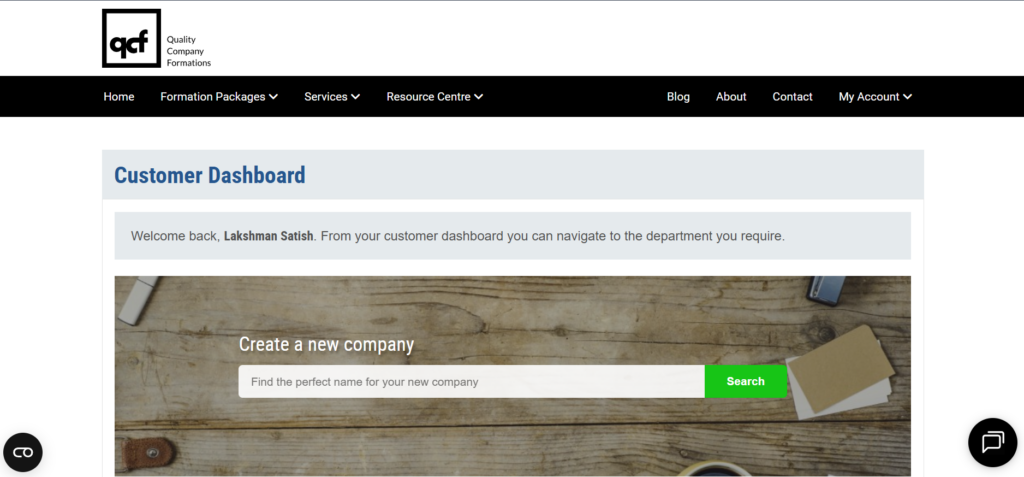
[Screenshot: QCF Customer Dashboard — March 30, 2026]
The interface is clean and functional. Five tabs across the top: My Account, Orders, Companies, Services, Finances. No clutter. No upsells pushed at you on the main screen. The company name search bar sits front and centre — useful if you’re still deciding on a name, redundant if you’ve already filed.
The mail scanning inbox is where physical correspondence to your London registered office appears as PDF scans once your company is active. This is what it looks like before your first letter arrives:
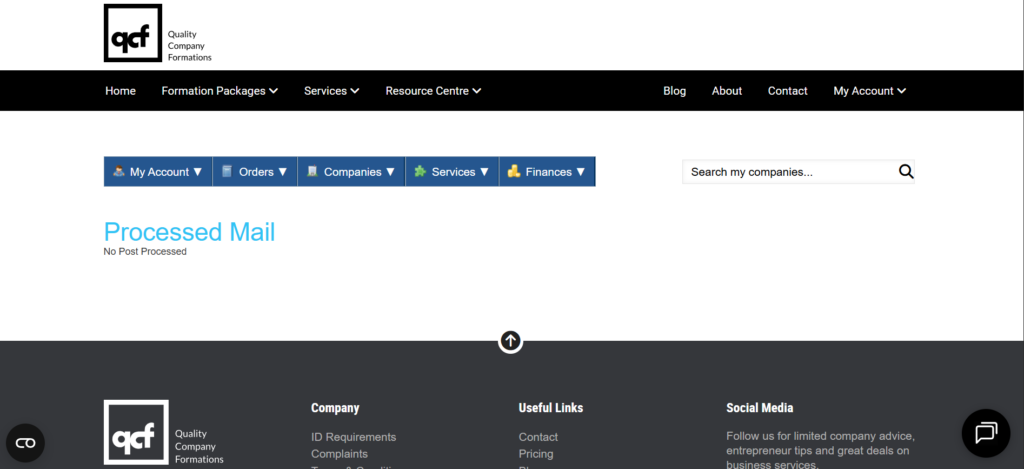
[Screenshot: QCF Processed Mail — March 30, 2026]
“No Post Processed.” That is day one. HMRC typically sends your UTR letter within 2–4 weeks of incorporation. When it arrives at your QCF London address, it appears here as a scanned PDF emailed directly to you. That is the entire value of the registered office service working as designed — you never need to be in the UK, you never need to chase a letter.
One limitation worth knowing before you start: there is no live CRN confirmation screen in the portal. After incorporation, you retrieve your Company Registration Number by downloading the Certificate of Incorporation PDF from the Companies tab. Thirty seconds of extra work — but know it in advance, because the first thing every bank KYC form asks for is the CRN and you want it ready before you open that form.
What I Liked About QCF: Three Things That Actually Hold Up
1. The all-in Year 1 price is genuinely hard to beat.
I have been through the checkout flows for seven UK formation agents. Seven complete flows, every add-on option, every pricing footnote. The lowest legitimate number I found — from an agent with a verified Trustpilot history and a Companies House-approved address — is £201.99. That number belongs to QCF.
The comparison that matters: 1st Formations‘ comparable non-residents package with both addresses added runs meaningfully higher in Year 1. Rapid Formations sits at a similar price point to 1st Formations once address services are included. QCF wins on Year 1 cost. That is a real advantage, not a marketing claim.
2. The Trustpilot score is not manufactured.
I read sixty reviews across different date ranges before I trusted this number. The pattern holds: fast turnaround, clean documents, support that resolves issues without escalation. More telling than the score itself is the volume — 2,491 verified reviews is not achievable through a review campaign. That is years of consistent delivery at scale. The negative reviews — there are some — cluster around two issues: delays on same-day orders filed close to the 12pm GMT cutoff, and occasional confusion about the WorldFirst banking referral. Neither is a dealbreaker. Both are predictable once you understand how the service works.
Here is the insider detail: a Trustpilot score this high from a volume this large is significantly harder to sustain than it is to achieve. Any formation agent can get fifty good reviews from early customers. Maintaining 4.8 across 2,491 reviews over years of operation means the core service is reliable at scale. That matters for a non-resident founder who cannot walk into a UK office if something goes wrong.
3. The document library is a quiet bonus most founders overlook.
When I opened it, I was expecting one NDA template and a generic invoice. What’s actually in there: employment contracts, shareholder agreements, privacy notices, a full NDA, and a basic invoice generator. Most formation agents give you a Certificate of Incorporation and a login. That is it.
For a founder in Chennai or Lagos issuing their first UK client contract, this library removes a real friction point. A basic NDA from a UK solicitor costs £150–400 to draft. An employment contract costs more. Getting both included in a £19.99 package — even in template form — is worth noting before you assume QCF’s low price means a stripped-down service.
What I Didn’t Like: The Banking Gap That Stung Me
This is the section nobody writes. Every QCF review I read before doing my own research mentioned WorldFirst in passing — one line, no explanation, move on. That is not good enough for a non-resident founder whose entire UK operating plan depends on getting the right bank account open in Week 1.
Here is the full picture.
QCF gives UK customers eight banking options.
NatWest, Tide, Monzo, Lloyds, Zempler, ANNA, Mettle — plus WorldFirst. UK-based founders can pick the account that suits their business model, their transaction volume, their industry.
QCF gives non-resident customers one: WorldFirst.
That is it. One option. No Wise. No Starling. No Tide. WorldFirst only.
WorldFirst is not a bad product. For the right founder it is exactly what they need — a UK sort code and account number, multi-currency support across 40+ currencies, strong integration with Amazon, AliExpress, and TikTok Shop. If you are an e-commerce seller receiving marketplace payments, WorldFirst works well.
But here is the reality of the non-resident founder market in 2026: the majority of Indian, UAE, Nigerian, and Singaporean founders setting up a UK Ltd are doing it for one of two reasons — consultancy invoicing to UK or EU clients, or agency work with UK contracts. For both of those use cases, the banking plan is almost always: form company → open Wise Business → receive client invoices.
WorldFirst does not sit in that stack. It does not satisfy Wise Business KYC requirements. It is not FSCS-protected up to £85,000 the way Starling Bank is. It is not a recognised high-street or regulated bank for the purposes of most HMRC correspondence that expects a UK banking relationship. And it does not help you get a Starling account, which remains the hardest and most valuable banking option for non-residents to access.
The result: if your plan is Wise Business or Starling, QCF’s banking referral is irrelevant to you. You will incorporate, receive your CRN, and then spend the next two weeks solving a banking problem that QCF did not help you solve — and that 1st Formations or Rapid Formations, with their broader banking panels, would have addressed from day one.
I did not incorporate through QCF for exactly this reason. I had already been through the Wise KYC delay with a different agent — my address wasn’t active on the Companies House register for 30 days yet when I applied, which triggered a hold and cost me £31 in FX fees on a workaround account. I was not going to repeat that with a formation agent whose banking referral took me further from Wise, not closer to it.
That is the banking gap. It is not fatal — you can solve it independently. But you should know about it before you pay £202, not after.
The Wise Timing Mistake I Made With a Different Agent — And Why QCF Customers Face the Same Risk
February 22, 2026, 4:17 PM IST, Chennai. This happened with a different formation agent — not QCF. I’m including it because the risk is identical, and because nobody warns you about it before you incorporate. Company active, address live, everything in order.
I opened the Wise Business application, filled in the company details, uploaded my passport, entered my UK service address. Three minutes. Clean. I hit submit expecting approval within 48 hours.
Wise came back with a hold.
Not a rejection. A hold. The message said my UK service address could not be verified as active on the Companies House register. The address was correct. The service address service was active. But Wise’s KYC system checks whether the address has been live on the public register for a minimum period — and my company was four days old.
I did not know this rule existed. Nobody mentions it. Not the formation agent. Not Wise’s onboarding flow. Not a single review I had read.
The hold lasted eleven days. I had a client invoice due in that window — £1,800 for a consulting engagement. The client could not pay into my new UK Ltd account because it did not exist yet. I used a secondary personal account as a temporary workaround. The currency conversion from GBP to INR on that account cost me £31 more than it would have cost through Wise Business.
£31 is not a catastrophe. But it was entirely avoidable.
Here is exactly what went wrong and the fix:
Here is the thing nobody puts in writing — including Wise. There is no published rule. No support article. No onboarding email that says “wait 30 days before applying.” It is a KYC system behaviour: Wise’s verification engine checks the Companies House register, sees a service address that went live four days ago, and flags it as elevated risk. Manual review. Hold. Eleven days of waiting for an account you thought you’d have in 48 hours.
The fix is simple once you know it exists: apply for Wise Business on the same day you incorporate, not after. The clock starts at incorporation. If you apply immediately, the hold — if it happens — resolves before you need the account. If you wait two weeks before applying, you have lost two weeks of that window for nothing.
This applies to every UK formation agent, including QCF. The moment your CRN is confirmed, open your Wise Business application. Do not wait until the account feels urgent. By then, it already is.
My Honest Warning: Who Should Run Away from QCF
Most formation agent reviews end with “it’s great for everyone.” That is not a review. That is a sales page. Three specific types of founder should not use QCF — and I’ll name them directly.
Founders forming more than two UK companies per year.
QCF’s system is built for single formations. There are no volume discounts, no bulk management tools, no dedicated account manager for multi-entity clients. If you are building a holding structure, running multiple trading companies, or incorporating on behalf of clients, QCF’s portal becomes a manual bottleneck fast. 1st Formations handles volume better — their infrastructure is built for it. QCF is not.
Anyone whose banking plan is Wise Business or Starling.
This one follows directly from the banking gap above — and it is the reason I did not incorporate through QCF. QCF’s non-resident banking referral is WorldFirst only. If your operating plan requires Wise Business as your primary account — consultants, agencies, service businesses invoicing UK clients — QCF leaves you solving a banking problem independently from day one. You can solve it. But you will spend time and potentially money doing it. 1st Formations and Rapid Formations have broader banking panels that reduce that friction. If Wise or Starling is the destination, start with a formation agent whose referral network points you in that direction.
Non-resident founders who need support in a language other than English.
QCF operates entirely in English. No Hindi, no Arabic, no Mandarin, no Yoruba. Their support is phone and chat — both English only. If you are setting up a UK Ltd on behalf of a family member or business partner in Chennai, Lagos, or Dubai who is not comfortable navigating UK compliance documentation in English, QCF will frustrate them at the first support interaction. For that use case, a formation agent with multilingual support or a UK-based accountant who can bridge the language gap is a better starting point.
Who My Research Says Should Use Quality Company Formations
The “run away” section names three founder types to avoid QCF. Here are three founder types for whom QCF is genuinely the right choice — and I mean that without hedging.
Marketplace sellers whose banking plan is WorldFirst.
Amazon, AliExpress, TikTok Shop, eBay — if your UK Ltd exists to receive marketplace payments and route them through a multi-currency account, WorldFirst is purpose-built for exactly that. It handles 40+ currencies, integrates directly with major marketplaces, and gives you a UK sort code and account number on day one. The fact that it is not Wise is irrelevant if you never needed Wise. QCF’s referral is not a limitation for this founder — it is the destination.
Solo founders forming one UK Ltd who want the lowest verifiable Year 1 cost.
If you are forming a single UK entity, you do not need volume management tools or a dedicated account manager. You need a clean formation process, a Companies House-approved London address, and a portal that does not break. At £201.99 all-in for Year 1, QCF delivers all three. I have been through the checkout flow for seven formation agents. This is the lowest legitimate number I have found.
Marketplace founders in Nigeria, Australia, and the US routing payments through WorldFirst.
A Lagos-based seller receiving Amazon UK payouts does not need Wise Business — they need a multi-currency account that integrates cleanly with the marketplace and converts to Naira at a competitive rate. WorldFirst does exactly that. The same logic applies to a Sydney agency receiving AliExpress or TikTok Shop payments in GBP, or a New York founder routing UK client payments through a holding entity. For all three, the Wise Banking argument that disqualifies QCF for Indian and UAE consultants simply does not apply. The formation quality is real, the price is the lowest I have found, and the WorldFirst referral is the right banking destination — not a consolation prize.
My Ugly Year 2 Math — The Number QCF Doesn’t Put on the Homepage
Nobody publishes this table. Formation agents have no incentive to show you what Year 2 costs — the headline number is always the Year 1 formation fee, and once you’ve incorporated, you’re already committed. Here it is in full.
| Item | Year 1 | Year 2 |
|---|---|---|
| Formation fee | £23.99 incl VAT | £0 |
| Companies House filing fee | £100.00 (no VAT) | £0 |
| Registered Office Address renewal | £46.80 incl VAT | £46.80 incl VAT |
| Service Address renewal | £31.20 incl VAT | £31.20 incl VAT |
| CS01 Confirmation Statement (Companies House) | £0 (first year included) | £50.00 as of March 2026 (no VAT) |
| Total | £201.99 | £128.00 |
Three things this table tells you that the QCF homepage does not:
Year 2 is cheaper — but not free. Unlike some formation agent reviews where Year 2 costs more than Year 1 due to price increases, QCF’s Year 2 drops to £128 because the one-time formation and Companies House fees disappear. That is genuinely good news. But £128 is still £128 — and it arrives whether your company traded a single pound or not.
The CS01 fee changed in February 2026 — most reviews quote the wrong number. Companies House raised the online Confirmation Statement fee from £34 to £50 on 1 February 2026. If you read a review quoting £13, £34, or any number other than £50 — it is out of date. Budget £50. File it online, not by post. The paper filing fee is now £110 as of February 2026 — more than double the digital rate (GOV.UK — CH fees).
Both address renewals are non-negotiable. Miss the Registered Office renewal and your address lapses on the Companies House register — which creates an immediate compliance flag and triggers a chase from Companies House. Miss the Service Address renewal and your home address reverts to the public register. Neither is a situation you want to manage from Chennai or Dubai. Set a calendar reminder at month ten. Do not wait for QCF to remind you — they will, but don’t rely on it.
The Year 2 budget is £128. Put it aside at incorporation. Treat it as a fixed annual operating cost from the moment your CRN is confirmed.
My Compliance Stack — Your Full UK Ltd Setup
Your UK Ltd needs four things to actually work: an entity, addresses, a bank account, and annual compliance filings. Most formation agent reviews cover step one and stop. The founders who end up with a registered company and no working bank account — sometimes for weeks — are the ones who didn’t know steps two through four existed until they needed them urgently.
Here is the full chain, in order, as it stands in March 2026.
Step 1 – ENTITY — Company Formation
You are here.
→ Quality Company Formations — Non-Residents Package (£19.99 ex-VAT | 24-hour formation | WorldFirst banking referral)
Also reviewed:
→ 1st Formations Review: Hidden Costs for Non-Residents — deeper banking panel, higher Year 1 cost
→ Rapid Formations Review: Is the £79.99 Same-Day Service Worth It? — same-day specialist, same Covent Garden building as 1st Formations
Step 2 – ADDRESS — Registered Office and Service Address
Both addresses are included in QCF’s Non-Residents Package for Year 1.
Before you choose your formation agent, understand what each address does and why getting them wrong costs money:
→ What is a Director’s Service Address vs Registered Office?
Annual renewal costs after Year 1:
- Registered Office: £39.00 ex-VAT as of March 2026
- Service Address: £26.00 ex-VAT as of March 2026
Step 3 – BANKING — UK Business Account
QCF refers non-residents to WorldFirst only. If your plan is Wise Business or Starling, source your banking independently.
→ Wise Business Review (coming soon)
→ Starling Bank Business Review (coming soon)
→ Tide Business Review (coming soon)
For WorldFirst: apply via the referral link in your QCF portal after incorporation.
Step 4 – COMPLIANCE — Annual Filing
Two deadlines every UK Ltd must hit every year without exception:
→ Confirmation Statement (CS01): Due exactly 12 months from incorporation date — not calendar year end. File online at Companies House. Fee: £50.00 as of March 2026.
→ Corporation Tax Return: Due 12 months after your accounting period ends. File via HMRC. First deadline arrives faster than most founders expect — set the reminder at incorporation, not at month eleven.
FAQ
Can I form a UK Ltd with Quality Company Formations if I’m based in India, UAE, Singapore, Australia, or the US?
Yes — and you never need to set foot in the UK. The entire process is online: company name search, ID verification, document upload, payment. Ten minutes on the form. Your Certificate of Incorporation arrives as a PDF within 24 hours on standard processing. The CRN inside it is what every bank, client, and HMRC filing will ask for first. Download it the moment it arrives.
What is the Companies House filing fee and is it included in the package price?
Budget £100. It is a government charge — not QCF’s fee, not subject to VAT, non-negotiable. It doubled from £50 to £100 on 1 February 2026. Any review quoting a lower number is out of date. Add it to QCF’s £23.99 package price and your Year 1 formation cost starts at £123.99 before addresses.
Does the Non-Residents Package include a UK address?
Both of them — and the distinction matters. The Registered Office Address is your company’s official address on the public Companies House register: government mail arrives here, QCF scans it and emails you a PDF. The Service Address is your personal director address: without it, your home address in Chennai, Dubai, or Lagos is on the public register for anyone to search. QCF includes both for Year 1. From Year 2, both renew — £39.00 and £26.00 ex-VAT respectively. Budget for it at incorporation.
What bank account do non-residents get through Quality Company Formations?
One option: WorldFirst. WorldFirst provides a UK sort code and account number, supports 40+ currencies, and works well for marketplace sellers on Amazon, AliExpress, and TikTok Shop. It is not FSCS-protected and does not satisfy Wise Business KYC requirements. If your banking plan centres on Wise Business or Starling, you will need to source that account independently — QCF’s referral will not get you there.
If you are an e-commerce seller on Amazon, AliExpress, or TikTok Shop, WorldFirst is purpose-built for your use case and the referral is genuinely useful. If you are a consultant or agency invoicing UK clients through Wise Business, it is not — and you should know that before you incorporate, not after.
How long does incorporation take?
Standard processing is 24 hours from submission. Same-day service is available as a £39.99 ex-VAT add-on, submitted before 12pm GMT on weekdays. In IST that is 5:30pm. In GST (Dubai) that is 4:00pm. In SGT (Singapore) that is 8:00pm. In AEDT (Sydney) that is 11:00pm. In EDT (New York) that is 8:00am. In PDT (Los Angeles) that is 5:00am — set an alarm or plan for next-business-morning delivery instead.
What is the Confirmation Statement and when do I need to file it?
Miss this and Companies House can strike off your company. The CS01 is an annual confirmation that your company’s details on the register are correct — directors, address, share structure. It is due exactly 12 months from your incorporation date. Not the end of the tax year. Not the end of the calendar year. Twelve months from the day your CRN was issued. File it online at Companies House. The fee as of March 2026 is £50.00. Set a calendar reminder at month ten — not month twelve.
What happens to my addresses in Year 2?
Both the Registered Office Address (£39.00 ex-VAT / £46.80 incl VAT) and the Service Address (£26.00 ex-VAT / £31.20 incl VAT) renew annually. QCF will send a renewal reminder but do not rely on it — set your own calendar reminder at month ten. If the Registered Office lapses, your address becomes invalid on the Companies House register. If the Service Address lapses, your home address reverts to the public record. Neither outcome is acceptable when you’re managing a UK entity remotely from India, Dubai, or Lagos.
Is Quality Company Formations’ Trustpilot score genuine?
I read sixty reviews across multiple date ranges before I trusted it. The volume and spread are consistent with a real operating history — not a review campaign. Any formation agent can generate fifty early reviews. Maintaining 4.8 across 2,491 over years of operation means the core service holds at scale. The negative reviews — a small minority — cluster around two predictable issues: same-day orders filed close to the 12pm GMT cutoff, and non-resident customers who expected a broader banking panel than WorldFirst. Both are explained in detail above. Neither is a dealbreaker if you go in knowing about them.
Disclaimer: This article is based on personal experience and publicly available information. I am not an accountant or solicitor. This is not legal or tax advice. Please consult a qualified professional for your specific business needs.